
Digital Marketing in Vietnam
Vietnam is a very online country. Walk into any densely populated café and there's a good chance most of the room is on a phone working, gaming, messaging or watching something.
Google is important, but Facebook, TikTok and local platforms like Zalo can play a much bigger role here depending on who you're trying to reach. That mix can look very different from what works in Western markets. So, finding the right channels starts with understanding who your target market is.
I've lived in Vietnam since 2014, working mostly with international companies or businesses targeting overseas markets. But during that time, I've also worked with Vietnamese businesses across a range of industries on organic growth projects to improve their local visibility. I even have a banned Facebook ad account to show for it.
This article was originally published in August 2021. But so much has changed since then that we’ve given it a full rewrite using our content refresh process. The new version reflects digital marketing in Vietnam today, the channels businesses should know about, and some of the lessons I’ve learned over the years.

One caveat before I go any further:
I'm a Canadian in Vietnam, so despite living here for 10+ years and having Vietnamese family, I'm still looking at the country from the outside.
That's largely because I've yet to master the language. And having studied anthropology, I'm aware of how closely language and culture are tied, and how important language is to understanding a society's values and worldview.
So, anything I say here about Vietnamese behaviour or culture should be read as respectful observations as an outsider, not someone pretending to be an expert on Vietnamese consumer habits.
How Digital Marketing Works in Vietnam Today
Digital marketing in Vietnam uses many of the same channels as elsewhere, but local platforms and buying habits can change the mix.
A local consumer brand might lean heavily on Facebook, TikTok, Zalo or Shopee at different points in the journey.
A business-to-business (B2B) service company operating in Vietnam might care much more about LinkedIn and its website, particularly if search visibility matters to how its customers find and research it.
The marketing mix can look very different depending on who you're trying to reach and how they buy.
Vietnam's digital market is much more mature than it was when I first wrote this article in 2021.
According to DataReportal, 85.6 million people in Vietnam were using the internet by the end of 2025, equal to 84.2% of the population. It also recorded 79 million social media user identities, but since one person will have multiple accounts, that figure shouldn't be read as 79 million individual people.
The important information for marketers is how fragmented that attention is.
Despite a declining user base in the West, Decision Lab's recent research found Facebook and Zalo remain central for communication and community, with TikTok becoming increasingly important among younger users. YouTube remains relevant across generations.
It’s also worth noting that Vietnam is a heavily mobile-connected market. A strategy that looks fine on desktop but is slow, awkward or difficult to act on from a phone is likely to miss a big part of how people actually experience the internet here.
But once you scratch beneath the surface, you'll find a lot more nuance. Broad claims about “Vietnamese consumers” can hide some pretty big differences between generations, locations and types of buyer.
For example, anyone who's traveled around Vietnam will likely notice considerable cultural and consumption differences between North, South and even Central regions.
So while national averages can be useful, they can also miss nuances that are far outside the scope of this article to uncover. It's just important to be aware of.

| Channel | Where it can fit |
|---|---|
| Google and search | Reaching people already researching a problem, product or service |
| Broad reach, communities and established social use | |
| YouTube | Education, entertainment and video discovery across different age groups |
| TikTok | Discovery, short-form video, creators and social commerce |
| Zalo | Local communication and reaching Vietnamese audiences |
| Shopee | Product discovery, marketplace advertising and ecommerce sales |
| TikTok Shop | Combining video, creators, livestreaming and ecommerce |
| More relevant for some professional and business-to-business audiences |
(I'd treat this as a menu of possible channels rather than a checklist.)
What About Email Marketing?
You’ll probably notice email marketing wasn't included.
That's because, while email can still be useful for business-to-business outreach and more formal correspondence in Vietnam, social platforms and messaging apps such as Zalo tend to play a much stronger role in how businesses reach and stay in touch with people.
In fact, there’s an argument that email is underused. A 2025 study on digital marketing in Vietnam describes personalized email marketing as an under-utilized opportunity and recommends newsletters, customer relationship management systems and other owned channels as ways to build first-party relationships rather than relying entirely on external platforms.
That fits with a point I’ll come back to later in this article. Facebook, TikTok and Zalo can all be incredibly useful, but there’s value in building channels and customer relationships you have more control over too.
In the real world, though, my experience has been a bit different.
While working with marketing teams, particularly with schools or other consumer-facing organisations in Vietnam, I’ve repeatedly heard some version of: our email open rates are so low that there’s little point sending them.
And in those teams, Zalo broadcasts are generally seen as far more effective.
A useful example of the of this article, that like other industries, digital marketing for schools must focus on the channels prospective families actually use, rather than treating a channel like email as a default.
Shopee and TikTok Shop Deserve Particular Attention
For businesses selling physical products in Vietnam, ecommerce platforms aren't just somewhere to complete a transaction.
They're also discovery and marketing channels.
Vietnamese consumers spent about US$16 billion across Shopee, TikTok Shop, Lazada and Tiki in 2025, according to Metric data reported by VnExpress. Shopee held about 56% of the market, while TikTok Shop had grown to more than 41%. Together, the two platforms accounted for roughly 97% of sales across the four marketplaces.
Other estimates differ slightly, but tell the same story. YouNet ECI put Shopee at 57.5% of the market in 2025 and TikTok Shop at 39.6%.
For marketers, that's interesting because the path from discovery to purchase can happen almost entirely inside the platform.
Influencers and Creators Play a Big Role Too
Influencer marketing is huge in Vietnam. And increasingly, it's tied directly to commerce.
Creators can introduce a product on TikTok, demonstrate it in a livestream, answer questions in real time and send people straight through to a purchase without them ever leaving the platform.
That combination of entertainment, recommendation and shopping is one reason influencer marketing has become such a big part of the digital mix here.
Campaign Asia reported in early 2026 that some brands in Vietnam are putting as much as 40% of their digital spend into influencer-led commerce. I wouldn't say that's indicative of an industry average, but it gives you an idea of how seriously some businesses are taking it. And I'm actually a bit surprised it's not a higher percentage.
In fact, WPP Media Vietnam has reported that 59% of advertisers it surveyed planned to increase spending on key opinion leaders (KOL) and key opinion consumer (KOC) marketing. TikTok accounted for more than 60% of interactions with sponsored content in its 2024 campaign data.
In Vietnam you'll often hear KOL and KOC. The distinction can get blurry, but broadly speaking, KOCs tend to lean more heavily on product experience and seemingly genuine recommendations rather than celebrity or a large personal following. They can be closer to what we'd call micro-influencers elsewhere, with the emphasis often on product experience and a more focused audience rather than celebrity reach.
There’s also more accountability around influencer marketing than there used to be. Changes to Vietnam’s advertising law that took effect in 2026 place clearer responsibilities on influencers, including checking information about the products they promote and making it clear when content is advertising.
So if you're marketing here with a bootstrapped budget, I'd recommend looking for people who already have the trust and attention of the audience you're trying to reach, and ask yourself whether working with them could help your target customer take the next step.
AI Is Becoming Part of Vietnam's Digital Landscape
One of the biggest changes since I first wrote this article in 2021 is the rise of AI.
A growing number of Vietnamese consumers are paying for ChatGPT, Gemini and Claude.
Sensor Tower data reported by VnExpress found that ChatGPT had more than 20 million monthly active users in Vietnam during the first half of 2026. With Vietnamese users spending $7.15 million USD through the mobile app during that first half of the year.
Claude is interesting for a different reason.
It had a much smaller audience of around 470,000 monthly active users, but still generated US$1.71 million in mobile revenue. Sensor Tower says its user base in Vietnam includes a lot of professionals and more advanced users willing to pay for premium features.
The number I was most shocked by was Gemini though. The study reported half the users of ChatGPT.
But on a closer look, it's simply because that reported number doesn't capture Google's full AI footprint.
Gemini models also power AI features inside Google Search, including AI Overviews and AI Mode. Someone can therefore use Google's AI regularly without ever opening the standalone Gemini app.
That's an important distinction when looking at AI adoption. Because the lines between search engines and AI assistants are already starting to blur.

And according to the research, overall spending is growing quickly too. Vietnamese consumers spent US$8.54 million on AI apps in the second quarter of 2026 alone, compared with US$4.99 million during the whole of 2024.
But again, like with the Gemini numbers, there are important limitations to these figures.
This particular study is tracking purchases made through Apple's App Store and Google Play, so web subscriptions and enterprise purchases aren't included.
Still, the direction seems similar to the rest of the world.
With AI becoming another part of how people in Vietnam work, research and find information online.
And search itself is changing at the same time, as a result. Google says AI Mode has now passed one billion monthly users globally, while AI-powered search increasingly lets people ask longer questions and follow them up conversationally.
Organic visibility is getting broader. People can still find you through Google, but they might also encounter you while researching a problem through an AI-generated answer or another AI tool before they ever reach your website.
What Makes Marketing in Vietnam Different?
Knowing which platforms are popular is only part of the job.
The harder part is understanding how the audience you want to reach uses them, what they care about, and how they research a decision.
That's why I wouldn't recommend building a Vietnam marketing strategy from national platform statistics alone.
Localization and International SEO is More Than Translation
This becomes even more important when you're marketing between Vietnam and another country.
Translating an existing page into Vietnamese doesn't automatically make it relevant to someone searching in Vietnam. The same is true for a Vietnamese company translating its content into English and trying to reach customers overseas.
International SEO involves researching each target market separately. Search behaviour can change, so the keywords and questions worth targeting in one country aren't automatically the ones that matter in another.
Good localisation also means adapting the content to the cultural and regional context of the people you're trying to reach, rather than simply changing the language. That's a recognised part of international SEO, not just a copywriting preference.
Let The Target Audience Direct Your Marketing Strategy
This is probably the recurring theme you'll notice throughout this article.
Before deciding what to publish or where to promote it, it's essential to understand the audience first.
- What are they looking for?
- What questions come up while they're researching?
- What would actually move them closer to doing business with you?
Search data can help answer some of that, but it shouldn't be the only input.
Sometimes the best research is simply asking existing customers what was going through their heads before they bought, what nearly stopped them, and how they'd describe the problem in their own words.
That's why I built a free customer research survey generator to make that part easier. It helps you create a short survey around things like pain points, buying triggers, objections and the language customers actually use.
Those answers can then be compared with search data to help decide which topics are worth creating content around for search, social media, paid promotion and the website and how best to talk about them.
Where Does Organic Growth Fit Into Digital Marketing in Vietnam?
My own approach to digital marketing usually starts with organic growth, particularly search. But that doesn’t mean I think SEO should be the main channel for every business.
For example, if you're selling arguably the best baked goods, moon cakes, and cinnamon rolls across HCMC, it's unlikely you'll get a lot of visitors from Google even if you target foreigners and rank high.
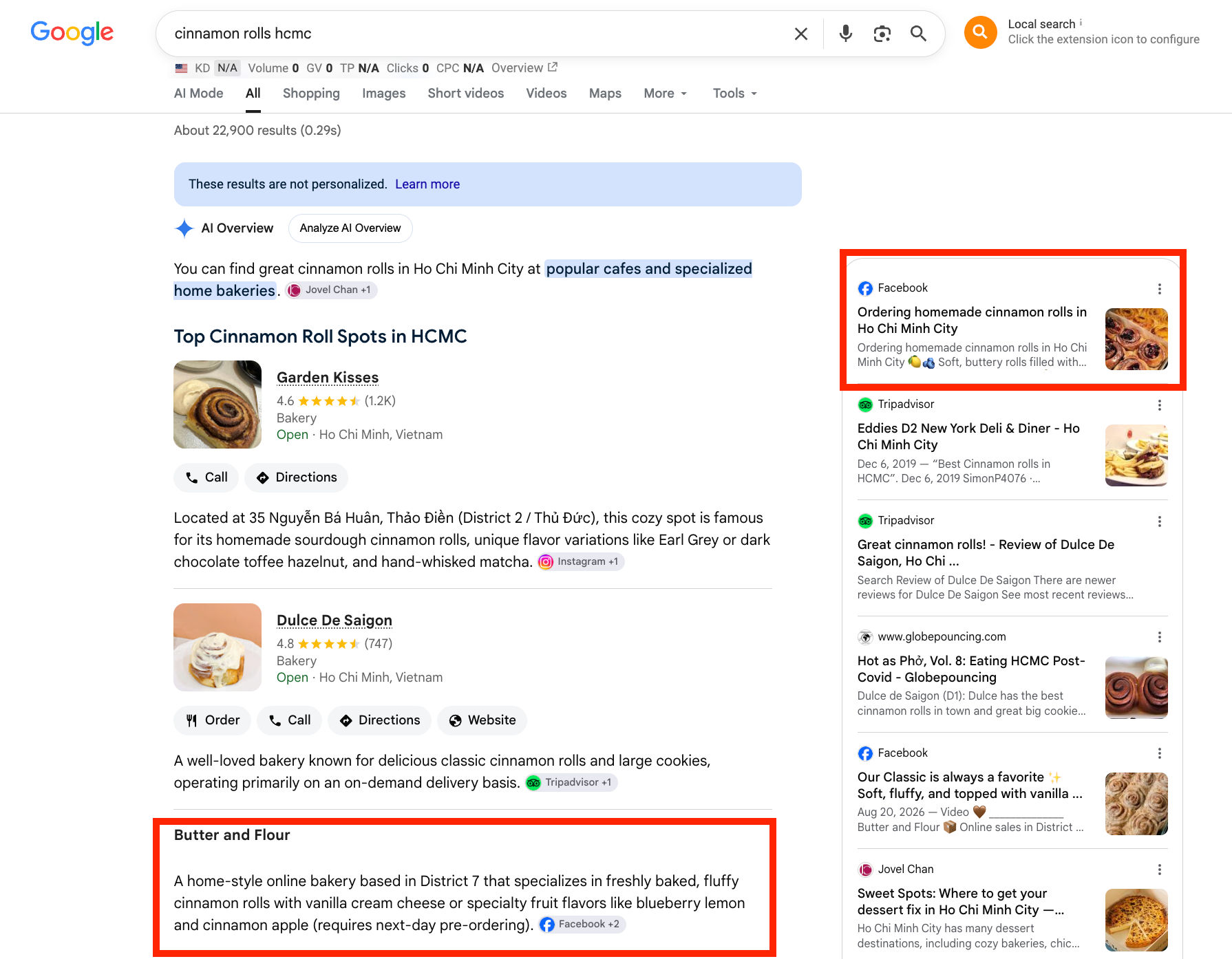
Social media and video will have a much bigger impact in that industry and your own website is definitely more of a nice to have than a need to have.
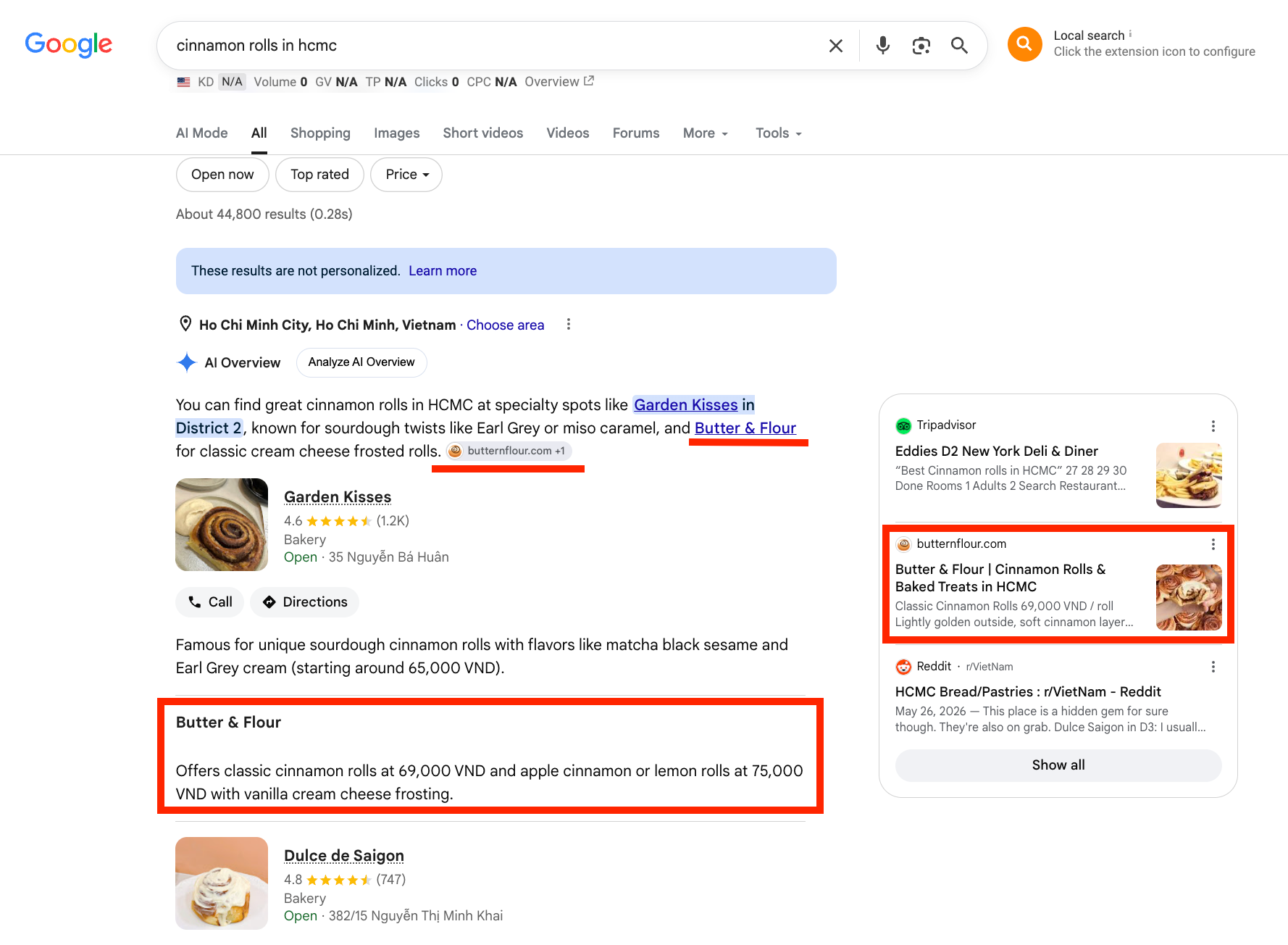
And that's why in the case of our new family-run brand Butter and Flour, the primary GTM strategy is organic social, word of mouth, events, and micro-influencer marketing.
But in general, I still like starting with organic search because it forces you to do some useful homework and ideas about your target audience before you start creating things.
Search gives you (quantitative) evidence of what people are interested in
Keyword research with the help of Ahrefs and high-engagement posts on relevant Facebook groups and subreddits can help reveal the questions people ask and the topics they research around a problem or service.
And clickstream data can add another layer by helping estimate demand around related topics and showing how people move between searches and websites.
None of this data is perfect, and I certainly don’t treat it as a crystal ball. Again, certain industries can largely ignore this tactic.
But for most niches it can give you quantitative evidence you can combine with what the business already knows about its customers, its offer, and the market.
That makes it a much better starting point than sitting around a table guessing what people might be interested in. Or what social post could go viral.
Sometimes the research confirms what you already suspected. And a lot of time, it can change the direction completely.
The research can shape more than SEO and AI visibility
This is one reason I don’t really think of keyword research as something that only belongs to SEO.
If you discover that potential customers repeatedly research a particular problem, that insight can affect the pages you create on the website.
It might change the way you position a service.
It could give you ideas for social content or advertising.
And it might reveal questions your sales team should be answering much earlier in the buying journey.
The search data is useful because it gives you a window into what people are already trying to understand.
Build useful assets somewhere you control and own
Once you find a question or topic worth investing in, I generally like building the strongest version of the answer on the website first.
That might be an article or a service page or a focused landing page.
The advantage of this, is you’re building something on a platform you control and essentially own. Social media can ban you, restrict you, or simply limit your reach because you don't post enough.
By publishing the ideas first on your site, you can improve it over time, link other useful pages to it and use it as a destination for traffic from other channels.
There's also a less theoretical reason I'm wary of building too much of a marketing strategy around platforms you don't control.
As I mentioned in the intro, I have a banned Facebook ad account.
I can't say with certainty what caused it, but I strongly suspect a nightlife-related project I worked on in Vietnam was the culprit.
Whatever the exact reason, I lost access to an advertising channel I'd previously been able to use.
And that's one of the risks with third-party platforms:
- Their rules can change.
- Enforcement can change.
- An account you've built around can suddenly become restricted, and you don't always have much control over what happens next.
That doesn't mean I wouldn't use Facebook ads again if they made sense for a project.
I'd just err on the side of caution and avoid relying on any single platform I don't control to be the only place the strategy lives - be that Facebook, TikTok, YouTube or even Google.
Your website gives you somewhere to store your core assets, information and customer journey under your own control.
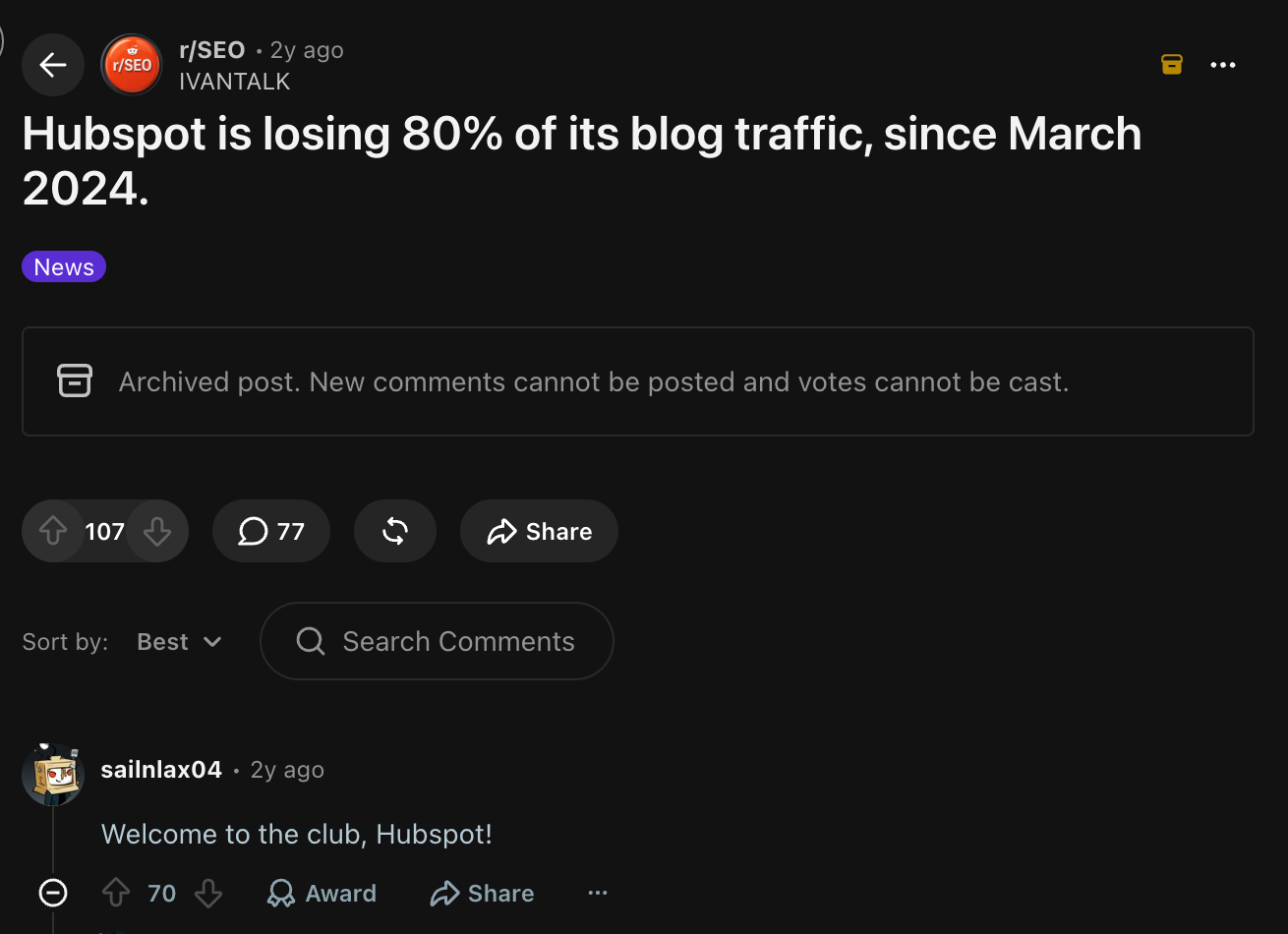
But of course, that doesn't mean you're independent of other platforms you rely on for organic traffic. Content marketing via your website relies heavily on Google for discovery. And Google is perhaps the most ruthless when it comes to algorithm updates.
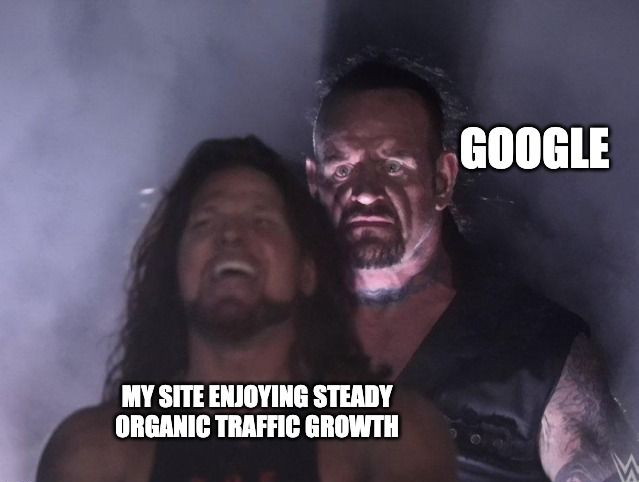
Hubspot and a number of other sites perhaps once considered 'too big to fail' have lost upwards of 80% of their traffic since 2024.
And just like with the example of my Facebook Ads account, I'm not saying that SEO is now a channel to ignore.
As digital marketers in Vietnam or anywhere else in the world, we must put ourselves out in front of our prospects wherever they may be found. And when a platform becomes stricter or harder to appear, we must adapt and level up.
And another piece of advice I'm trying to convey regarding your content strategy and website is that if one traffic source changes, the content and pages you've invested in are still yours to access, refresh, and repurpose however you'd like.
Adapt your ideas for other platforms and mediums
Publishing the original page doesn’t mean the work is finished.
One good piece of research can give you material for several other channels:
- A section of an article might become a 'zero click' Facebook or LinkedIn post simply meant to spark comments and conversations on the platform.
- One of the findings could become a short video.
- A customer problem uncovered during the research might become the angle for an ad.
- Heck, your overall niche can become the basis of a facebook group.
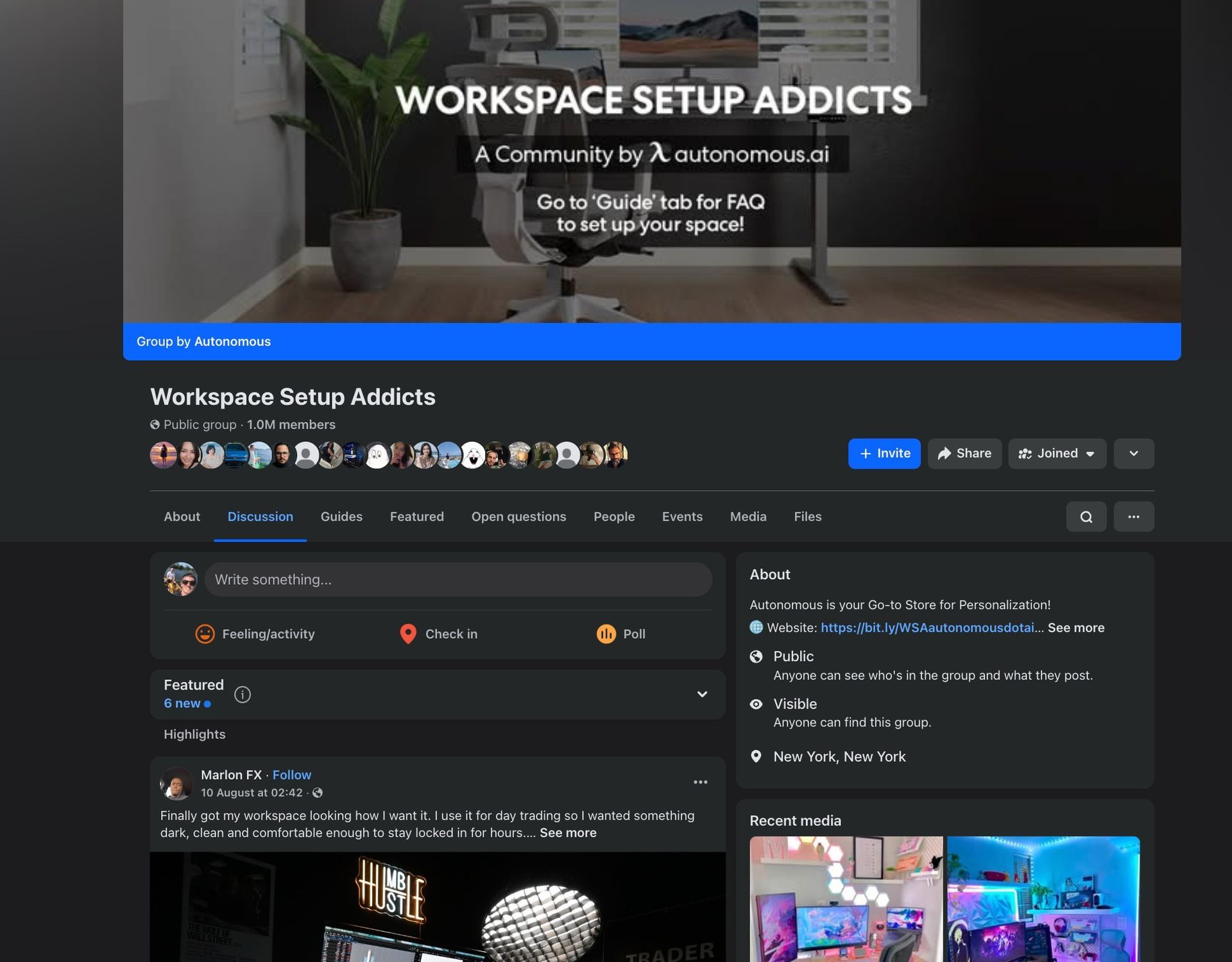
For a business targeting customers in Vietnam, an idea can also be adapted for Zalo, Shopee, TikTok or another platform if that’s where the audience is.
Of course, I wouldn’t simply copy and paste the website version everywhere.
Someone searching Google with a specific question is in a different context from someone scrolling through TikTok or opening Shopee because they’re ready to shop.
But the overall topic can stay the same while the format, message and next step change.

Give each channel a job
The website doesn’t always have to be the final destination either.
Sometimes you want someone to read a landing page.
In another situation, it might make more sense for them to connect through Zalo or go directly to a product listing on Shopee.
The useful question is what you want that particular channel to help the customer do next.
You’re not trying to be everywhere, at least not at first. You'll likely hear more and more people promote the idea of search everywhere optimization. And that's certainly a solid strategy for big marketing teams to use. But many companies aren't afforded the budgets necessary to achieve that.
So, instead you’re trying to understand where the right people are, what they care about, and how a target number of different channels can help move them closer to a decision.
When the Business Is in Vietnam but the Audience Isn't
As I mentioned in the intro, a lot of the work I've done from Vietnam targets elsewhere.
Companies may be based here, but the customers they want to reach are somewhere else.
In that case, Vietnam might be the operating base, but the marketing strategy closely follows what I've shared above but needs to follow the audience you're actually trying to reach.
What This Can Look Like in Practice
An example that comes to mind regarding repurposing site content into other formats is from fram^, a Vietnam-based B2B company selling AI implementation services to international clients.
First we identified a number of relevant topics for articles that can help flesh out an AI category on their site.
Then identified additional topics that could make for helpful informational videos and all complement each other.
The topics could then be adapted into different formats, rather than treated as a single piece of website content.
When I later searched Google for questions to ask your AI implementation partner, one of fram^’s LinkedIn posts appeared prominently in the AI Overview source panel.

What's interesting is that the post didn’t need huge visible engagement to appear there.
Not to say likes don’t help with visibility, or that posting on LinkedIn guarantees AI visibility.
But it does show why I like starting with useful audience research.
If you find topics your prospective buyers genuinely care about, you can build a strong answer once, then adapt it for different places where those buyers might discover it.
And sometimes those secondary formats can earn visibility of their own, even more than the original. And so long as they're all tied together, you'll still benefit regardless.
AI Makes Translation Easier, Not Market Understanding
AI has made one part of this much easier.
You can now produce grammatically decent content in another language in seconds. And you can even use AI to create video avatars for highly technical talking head explainer videos.
But that doesn't mean it'll automatically help you understand the market.
You still need to know what people care about, how they research the problem and what makes your offer relevant to them.
That's why I still come back to audience research before content production.
Final Thoughts on Digital Marketing in Vietnam
So, as mentioned before, digital marketing in Vietnam has changed a lot since I first wrote this article in 2021.
The country is more connected, eCommerce is more important, AI is changing how people search and research, and the mix of platforms people use keeps getting more complicated.
But I don’t think the answer is to chase every new channel.
I think the best strategy starts with the audience. When you focus on what they care about, what they’re already researching, and what you want them to do next. You can decide where search, social media, eCommerce, paid promotion or platforms like Zalo fit into the wider strategy.
My own preference is to start with organic growth because it forces you to do that research first. It also gives you the chance to build useful assets on a website you control, which you can then adapt for other channels where they make sense.
Sometimes that means sending people back to your website.
Sometimes the better next step might be Shopee, Zalo, a Facebook group or somewhere else entirely.
But the point is to make each channel earn its place and connect in some way that adds value to your brand and customers.
If you’re curious where organic growth opportunities show on your own site, get in touch and we'll send you a friendly, no-obligation report!

About Will James
Will is a content strategist and co-founder of 8-Bit Content. He helps businesses get more from their content and has spent more than a decade working across search, publishing, and marketing. In his free time, he’s almost certainly with family and friends, off on an adventure, learning something new, or trying to get a cat’s attention.

About Joshua James
Joshua is an education leader and co-founder of 8-Bit Content. He has spent more than 15 years helping schools grow, strengthen their digital presence, and create safer learning environments. In his free time, he’s usually with his two kids, taking on a new challenge, or pretending he has reached the end of his to-do list.



Let’s grow your online visibility together!
Get practical content tips and checklists
Contact Us
You can also find us here:
