
Local SEO for Universities and Colleges: Higher Education Essentials
Local SEO for higher education helps your institution appear when prospective students and families search for programs, campuses, or services in a specific location.
Before someone books a campus tour, they usually want to know whether the school is a good fit. Students look for practical details that make campus life tangible. Parents look for proof that the institution supports students and justifies the investment.
Local search helps shape those first impressions. Because accurate location information, credible reviews, and useful campus content can build confidence before someone visits your admissions pages.
After more than 15 years in education leadership, I’ve seen how important that visibility is for institutions without built-in brand recognition. A strong local SEO foundation can help turn local searches into program discovery and enrolment confidence.
Local SEO is one part of a broader higher education SEO strategy, and its job is to help students understand the place behind the program. Doing that well starts with understanding how Google evaluates local visibility, so let's get into that.
Key Takeaways on Local SEO for Higher Education
Local SEO helps colleges and universities appear when students and families search for programs, campus visits, and other location-specific information.
To make the most of this opportunities, I recommend you:
- Make every important location easy to verify. Keep your Google Business Profile, contact information, and map details accurate so students can verify the right location.
- Use specific profile fields. Choose the most accurate categories, keep hours current, and complete the profile fields that help students and families verify fit.
- Match local search intent. Build pages around three questions that affect action: program location, campus visits, and daily life.
- Use reviews as content intelligence. Monitor reviews and respond professionally, then use recurring student and parent concerns to fix the campus information causing uncertainty
- Promote timely next steps. Use Google Posts, campus tour pages, and deadline reminders where they can move searchers toward a visit, inquiry, or application.
- Build local trust beyond your website. Build local authority through community partnerships, trusted listings, and verifiable source material.
- Measure enrolment behaviour.
Track the actions closest to enrolment: campus tour bookings, inquiries, and application starts.
What Students, Parents, and Other Searchers Want to See Quickly
Different people use local search with different priorities. Your local SEO strategy should help each group find the right information fast.
- Prospective students want to know what daily life will feel like. Show campus photos, housing, and transit because those details help students picture everyday life.
- Parents and families want confidence that the school is safe, reputable, and worth the investment. Make reviews, support information, and campus safety details easy to find so families can judge fit.
- International students need location context they may not already have. Explain the city, housing, and airport access first because international students need enough local context to judge daily life before they arrive.
- Transfer and commuter students often care about convenience. Highlight parking, transit, and program-specific campus locations so commuter students can judge practical fit.
- Graduate and professional students udge fit through credibility and access. Show employers, research facilities, and professional networks that make the location valuable to the program.
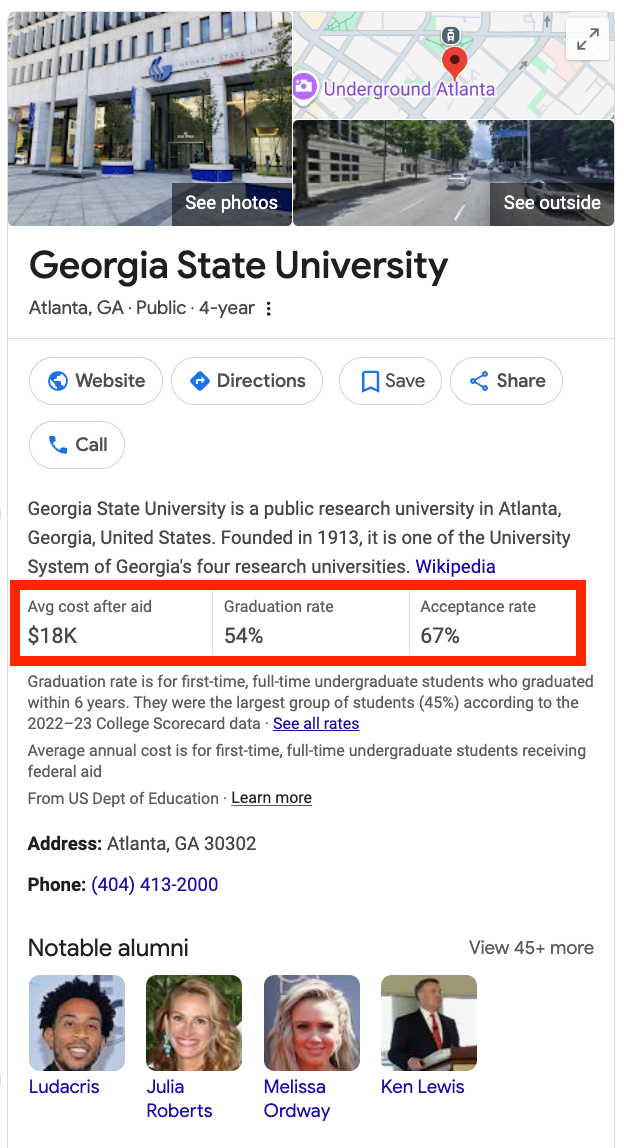
Google results for universities often surface decision-critical information before a searcher reaches the website. Students and families may see cost, directions, and reviews directly in search, so those first-touch details need to be accurate.
For instance, the Georgia State University result above shows an $18K average cost after aid, a 54% graduation rate, and a 67% acceptance rate.
Local SEO keeps those first-touch details accurate enough to build confidence.
How Local SEO Works for Colleges and Universities
Local SEO helps Google choose the page that best matches the searcher's location and intent.
For higher education, that can include searches like:
- universities near me
- colleges in Atlanta
- nursing programs in Chicago
- campus tours near me
- university housing in Boston
- business schools in Toronto
- Georgia State University directions
- best colleges near public transit
Google weighs
relevance and distance, while prominence reflects broader institutional trust. For colleges and universities, local visibility depends on whether the page matches the search and the campus is nearby; prominence then reflects the institution's wider trust signals.
| Local ranking factor | What it means for higher ed | What to improve |
|---|---|---|
| Relevance | Google needs to understand what your campus, department, or program offers. | Use accurate categories, clear page titles, and local program content. |
| Distance | Google considers how close the campus or facility is to the searcher or searched location. | Make addresses, maps, and campus locations easy to find. |
| Prominence | Google looks at how well-known and trusted the institution appears online. | Build reviews, local citations, and strong campus pages. |
This is why university local SEO needs location-specific entry points instead of one general page.
A prospective student may start broad and narrow the search as a campus visit becomes more likely.
Your local SEO strategy needs to make each important location easy to find, understand, and trust.
Optimize Your Google Business Profile for Complex Campus Environments
Your Google Business Profile is often the first place students and families see your institution in local search.
It can show the details students use to verify a location before reaching your website, making the profile part of the decision. For higher education, that makes your profile more than a directory listing. It is often a first impression.
Start with your main campus profile. Make sure the institution name, address, and website link are accurate.
Then audit whether important public-facing locations need their own profiles. This may include admissions offices, libraries, or public-facing clinics.
Separate profiles usually make sense when a location serves a distinct public purpose that searchers cannot complete through the main campus profile.
| Profile type | When it may need its own profile | Why it matters |
|---|---|---|
| Main campus | Always | Helps people find the institution, directions, and reviews. |
| Admissions office | When it has a distinct location or visitor process | Helps prospective students and families find the right place for tours, meetings, and open houses. |
| Library | When it serves students or the public as a distinct facility | Helps searchers find hours, accessibility details, and study spaces. |
| Athletics facility | When it hosts public events or student services | Helps visitors find games, parking, and entrances. |
| Clinic, lab, or public service centre | When it serves the public or has its own contact process | Helps patients and other visitors reach the right location. |
| Individual departments | Only when they are distinct, public-facing entities | Helps searchers find the right school, office, or program location without creating duplicate listings. |
At a minimum, each active profile should include:
- Accurate institution or department name
- Correct address and map pin
- Local phone number or correct contact route
- Relevant website link
- Clear primary and secondary categories
- Recent campus or facility photos
- A concise description
- Review monitoring and response process
- Updated accessibility, parking, transit, and visit details where relevant
For multi-campus institutions, this work is even more important. Each profile should help students and families find the right location, confirm key details, and take the next step with confidence.
Optimize the Profile Fields That Influence Local Visibility
Accuracy is the baseline. The next step is making sure each profile gives Google and searchers enough detail to understand what the location actually is.
Choose specific categories
Your primary Google Business Profile category matters. In the 2026 Whitespark Local Search Ranking Factors report, local SEO experts ranked Primary GBP Category as the #1 Local Pack/Maps ranking factor.
That does not mean categories are the only thing that matters, of course. But it does mean colleges and universities should choose the most accurate primary category for each legitimate public-facing profile.
Many institutions set every profile to “University” or “College” and stop there. That can work for the main campus, but specialized public-facing profiles need a category that describes what searchers find there.
For example, a law school profile should use a law school category where available. A nursing faculty may be better represented as a nursing school. A campus library should use a library-specific category. A teaching clinic should use the most accurate clinic or healthcare category.
| Profile | Weak category choice | Stronger category choice |
|---|---|---|
| Law school building | University | Law school |
| Nursing faculty | College | Nursing school |
| Campus library | University | University library |
| Teaching clinic | University | Medical clinic (plus relevant specialty) |
| Athletics complex | University | Stadium, arena, or sports complex as appropriate |
You can also use additional categories to describe other services or functions the location genuinely provides.
And be sure to review categories every six months since Google updates category options over time, and a better category may become available.
Fill Out the Services Section
The Services section can help clarify what each location offers.
For higher education, services should focus on tasks students actively search for during enrolment, especially when the relevant office is hard to find.
Use Google’s predefined services when they genuinely apply. Add custom services when Google does not provide a close match.
This is especially useful for long-tail searches where students and families need to find the right office for a specific task.
Keep Hours Accurate Where They Apply
Hours matter most for profiles tied to specific public-facing locations.
That includes admissions offices, libraries, bookstores, and clinics.
Keep regular hours, seasonal schedules, and special closures updated. A prospective student who finds the right profile but sees outdated hours may lose confidence before they reach your website.
Use “open 24 hours” only when the location truly operates that way.
For main school or university profiles, follow Google’s guidance carefully.
Some institution-level profiles do not need standard business hours because their availability is not tied to walk-in service.
Set Every Relevant Attribute
Attributes help searchers filter for specific needs.
For colleges and universities, prioritize attributes that help students verify access and practical fit.
These fields are easy to overlook, but they matter when students or families search with specific needs in mind. A campus building with accessible entrances, parking, or washrooms should make those details clear wherever the profile allows it.
Review attributes for each active profile at least twice a year.
Assign Clear Profile Ownership
Universities often have several teams touching local profiles, so clear ownership matters.
That can create unnecessary risk. Changes to core identity fields can trigger verification issues, so route them through the profile owner. The same uncontrolled changes can create conflicting profile states that weaken visibility.
Assign one owner for each profile. Route sensitive changes through that person before anything goes live.
Use Google Posts to Promote Deadlines, Tours, and Open Houses
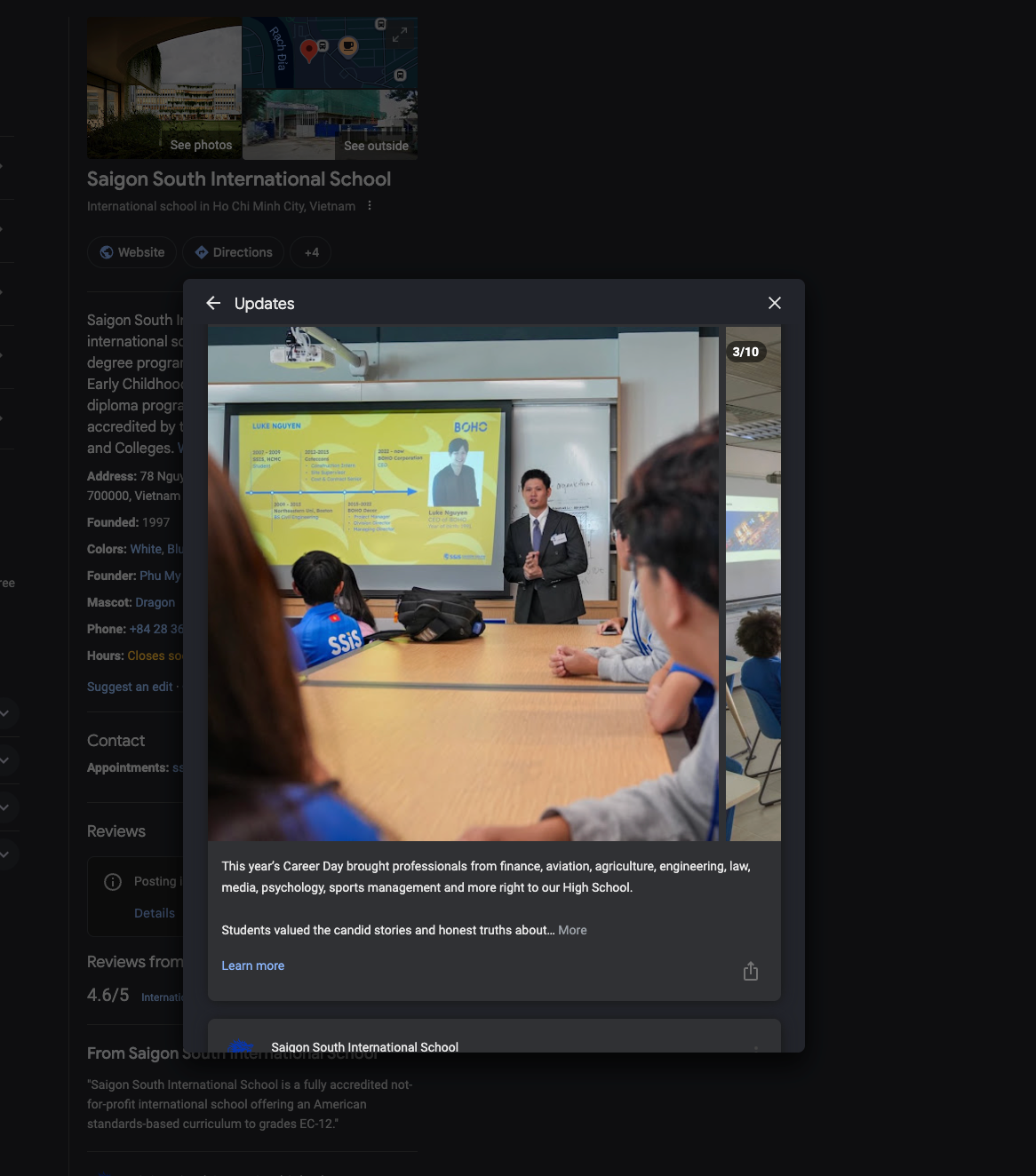
Google Posts appear in the Updates section of your Google Business Profile.
For colleges and universities, they are useful promotional space in a high-intent search result. The people seeing these posts are already evaluating your institution, so write for decision-ready searchers.
Use posts to help them take the next step.
Strong Google Posts for higher education include:
- Application deadline reminders with a clear link to apply
- Open house and campus tour announcements with registration links
- Scholarship and financial aid deadlines
- Program highlights tied to intake periods
- Standout reviews or student outcomes
- Rankings, accreditations, and awards that build confidence
- Public lectures, exhibitions, games, performances, and community events
Avoid filling this space with internal updates that only matter to current staff or students.
A generic internal update may suit another channel, but it rarely helps someone make a school decision.
One useful post per week is enough to keep the profile active. Give open houses and application deadlines their own posts because both create a clear next step.
And you can use the first 100 characters strategically to entice clicks, add UTM tracking to post links, and send each post to the most relevant landing page.
These posts won't directly improve rankings, but they can influence what people do after they find you. Use posts to move high-intent searchers toward the next enrolment action rather than simply keeping the profile active.
Capture Local Search Terms in Your Content Strategy
Local keyword strategy for higher education usually falls into a few recurring search patterns.
Program + Location Searches
These searches come from students who know what they want to study and are comparing options in a specific place.
This could be:
- MBA programs in Boston
- Engineering schools in Texas
- Art colleges in Southern California
- Nursing programs in Chicago
Create program pages that explain how location improves the course experience for a prospective student. Do not force the location into every heading. Use it where it helps the reader understand fit.
Campus Visit Searches
These searches come from people who are close to taking action.
Think:
- How to get to [University]
- Parking at [University]
- Campus tours near me
- Hotels near [University]
Support these searches with visit pages that remove the biggest pre-trip uncertainty: how to reach the campus.
Campus Life and Community Searches
These searches help students picture daily life.
Start with:
- [University] neighbourhood
- Things to do near [University]
- [University] city life
- Best areas to live near [University]
Create content that shows the local experience around the institution. Focus on the local details that determine whether daily life there feels workable. Topics like housing, food, transit, recreation, safety, internships, culture, and student communities.
For example, Boston University's "Living in Boston" section gives prospective students enough local context to plan around the city, including its weather... All optimized for location-specific keywords.
Strong local keyword targeting helps students understand how the program connects to the place they may actually live in.
Create Location-Based Content That Supports Enrolment
This location-based content helps prospective students understand what life will feel like beyond the classroom.
That matters because students are choosing a place to live as well as a program. A strong local content strategy should help students picture whether the surrounding community supports the life they want.
Show What Daily Life Looks Like
Create content that answers practical student-life questions.
This can be like:
- Where students live
- How students get around
- Where students eat
- What the neighbourhood feels like
- Where students study outside class
- What students do on weekends
- How safe and accessible the area feels
- What support services are nearby
This content does not need to read like a travel guide. It should help prospective students decide whether they can realistically build a routine there.
Connect the Location to Student Outcomes
The surrounding area can also strengthen your academic and career story.
For example, a university in a major business district can show how nearby employers strengthen internship access and career relevance. A health sciences program near hospitals or clinics can explain how proximity supports hands-on learning and career preparation.
This is where local SEO becomes more than visibility. It helps connect your location to the student’s future.
Build Content Around the City, Neighbourhood, and Campus Experience
Useful location-based content can include:
- Student guides to the city or neighbourhood
- “Things to do near campus” articles
- Housing and commuter guides
- Public transit and parking explainers
- Local employer and internship pages
- Campus safety and accessibility pages
- Seasonal guides for new students
- Event pages for open houses, tours, and community activities
- Student-written guides to local restaurants, study spots, and social spaces
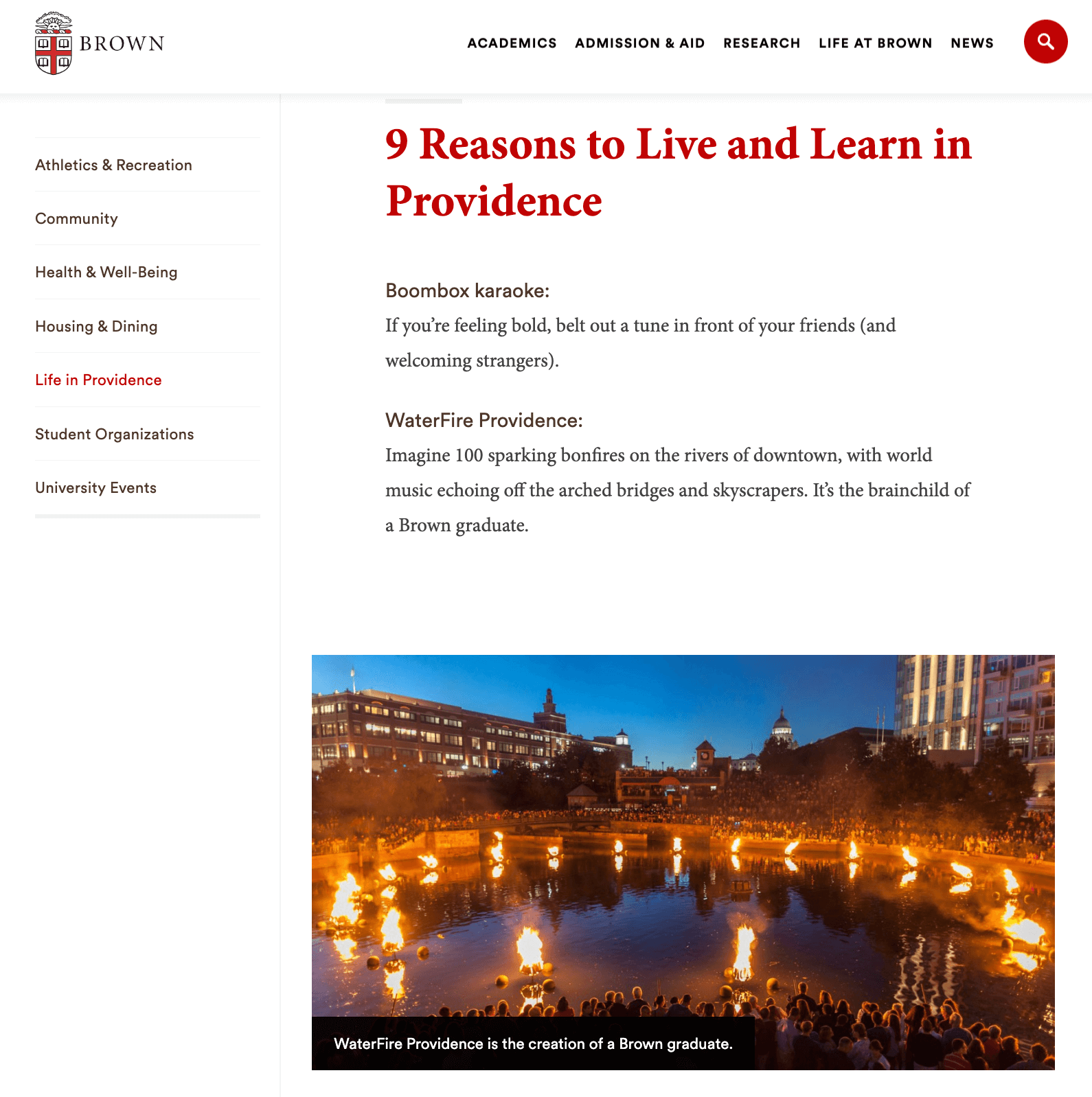
Brown University does this well with its “Life in Providence” content. The page connects the university experience to Providence by showing how the city shapes what life at Brown actually feels like.
For higher education institutions, this kind of content earns visibility by giving prospective students useful local context. And it also gives Google stronger local context while giving prospective students a clearer reason to take the next step.
Manage Local Reviews and Reputation
Reviews are one of the fastest trust signals students and families check in local search.
They can shape first impressions before someone visits your website. A prospective student may read reviews to judge whether everyday campus life feels supportive and workable before deciding to visit. A parent may read the same reviews for a different signal: whether the institution responds responsibly when problems surface.
That makes review management part of your local SEO strategy.
Start by tracking reviews across the places students and families already use. This can include Google, Facebook, Niche, College Confidential, Reddit, student forums, and program-specific review sites.
Then look for recurring themes. Do students mention confusing parking? Poor communication? Great faculty support? Strong campus culture? Safety concerns? Helpful admissions staff? Those patterns should shape content that resolves the same uncertainty before it becomes another review.
A good review process should include:
- Monitoring reviews weekly
- Responding to positive and negative reviews in a calm institutional voice
- Escalating serious complaints to the right internal team
- Identifying recurring concerns students and families mention
- Updating campus pages when reviews reveal missing or unclear information
- Encouraging reviews ethically from students, alumni, visitors, and event attendees
For institutions with multiple campuses, public-facing departments, or review-sensitive programs, this work can quickly become hard to manage internally. Our online reputation management services help strengthen the public record around your institution with clearer profiles, better source material, stronger third-party signals, and ongoing search and AI visibility checks.
A strong review process helps your institution spot recurring concerns, respond with care, and turn reputation signals into better student-facing content.
Build Local Authority Through Community Partnerships
Local links and mentions help search engines understand your institution’s role in the surrounding community.
For higher education, the best local links usually come from real relationships. These links are strongest when they come from organizations that already work with your institution or contribute to student outcomes.
Instead of chasing generic backlinks, focus on partnerships that already support student outcomes.
Useful local authority signals can come from:
- Employer partner pages that mention internships, placements, or graduate hiring
- Local news coverage about research, events, student projects, or community impact
- Chamber of commerce or city pages that list the institution as a local partner
- Nonprofit partner pages connected to volunteering, service learning, or fieldwork
- Hospital, clinic, or lab pages connected to placements and research
- Event pages for open houses, lectures, performances, athletic events, and community programs
- Local business pages that mention student discounts, partnerships, or campus services
Use Campus Events to Strengthen Local Visibility
Campus events are especially useful at supporting local SEO when they are published as useful, location-specific pages.
A public campus event should have its own page when searchers need practical information before attending, with the event details moved into a short checklist.
Add event schema markup to important event pages so search engines can understand the event details and qualify the page for richer search results.
Write event copy with local search behaviour in mind. Include only the location context readers need to understand where the event fits.
For example, a prospective student might search for open houses in Boston, university events near downtown Toronto, or public lectures near UOT (campus name).
Cross-promote events with local venues and community partners when the event happens off campus. Off-campus events can create useful content for both organizations when the partner venue gives the event a stronger local connection.
This helps your institution build stronger local signals while giving prospective students more ways to experience the campus community before they apply.
Check How AI Tools Describe Your Institution
Prospective students and parents will almost certainly also use AI tools to research schools.
They may use several AI tools to ask questions like:
- What is [University] like?
- Is [University] safe?
- What are the best nursing programs in Chicago?
- Is [College] good for international students?
- What is student life like at [University]?
These answers often draw from your website, Google Business Profile, Wikipedia, Wikidata, review platforms, news coverage, Reddit threads, forums, and third-party directories.
And if those sources are outdated, thin, or inconsistent, AI-generated answers may describe your institution poorly.
Treat this like a reputation and content audit.
Ask the Questions Yourself
Search your institution name in major AI tools.
Then test your most important program-and-location queries. For example, search for nursing programs in [city], business schools near [city], or what is [institution] like for international students.
Log the answers. Flag anything that could mislead prospective students.
Check the Sources Being Cited
Look at which sources the tools reference.
AI tools often lean on third-party sources, so prioritize those that repeatedly appear in answers about your institution.
Fix inaccuracies at the source when possible. Start with your most visible third-party profiles and any page that AI tools cite repeatedly.
Standardize Your Institution Description
Use the same clear one-line institution description wherever major search and AI sources represent your school.
This gives search engines and AI tools a consistent definition to work from.
For example:
[Institution] is a [type of institution] in [city/region] known for [core strengths], [student audience], and [specific academic or community focus].
Keep this description accurate, specific, and easy to reuse.
Keep Structured Data Current
Structured data helps search engines understand important facts about your institution.
Review only schema types that accurately describe the institution and page content. Keep structured data current whenever the underlying institutional information changes.
This supports traditional search visibility and gives AI systems clearer information to interpret.
Re-Check AI Answers Quarterly
AI answers change over time.
Review them a few times a year, especially before periods when prospective-student demand is likely to change.
Local SEO and AI visibility depend on the same foundation: information that is consistent enough for search systems and prospective students to trust.
Measure Local SEO Success for Higher Education
Traditional SEO metrics do not tell the full local search story.
A local SEO page may influence a student before they ever submit a form. They may use local search to build confidence before returning through another page to take an enrolment-related action.
That means your reporting should connect local visibility to enrolment behaviour.
Track Google Business Profile Actions
Start with the actions people take directly from your Google Business Profile.
Track:
- Website clicks
- Direction requests
- Calls
- Photo views
- Review volume and sentiment
- Search terms that trigger your profile
- Interactions with individual campus or department profiles
These actions show whether people can find and engage with your institution before they reach the website.
Track Local Website Behaviour
Next, measure what local search visitors do once they land on your site.
Track visits to:
- Campus pages
- Program + location pages
- Parking and directions pages
- Campus tour pages
- Housing and residence pages
- Student life pages
- Event pages
- Local guides and neighbourhood content
Look for behaviour that shows growing intent. A student who visits a nursing program page, checks directions, reads about housing, and opens the campus tour page is more valuable than a visitor who only reads one blog post.
Track Enrolment-Focused Actions
Local SEO should eventually connect to admissions and enrolment outcomes.
Track actions like:
- Campus tour bookings
- Open house registrations
- Inquiry form submissions
- Calls to admissions
- Program brochure downloads
- Application starts
- Application completions
- Return visits from local search users
You do not need every metric to be perfect. You need enough visibility to understand whether local search is helping prospective students move forward.
Measure What Different Audiences Care About
Different searchers leave different signals.
Prospective students often linger on pages that make everyday campus life easier to picture. Parents spend more time on pages that show whether the institution feels safe and dependable. Commuter students care most about whether campus access fits real-life constraints such as childcare and evening schedules.
Review these patterns regularly. Then use them to improve your content, internal links, Google Business Profile details, and campus visit calls to action.
The strongest reporting connects local visibility to evidence that prospective students are moving toward enrolment.
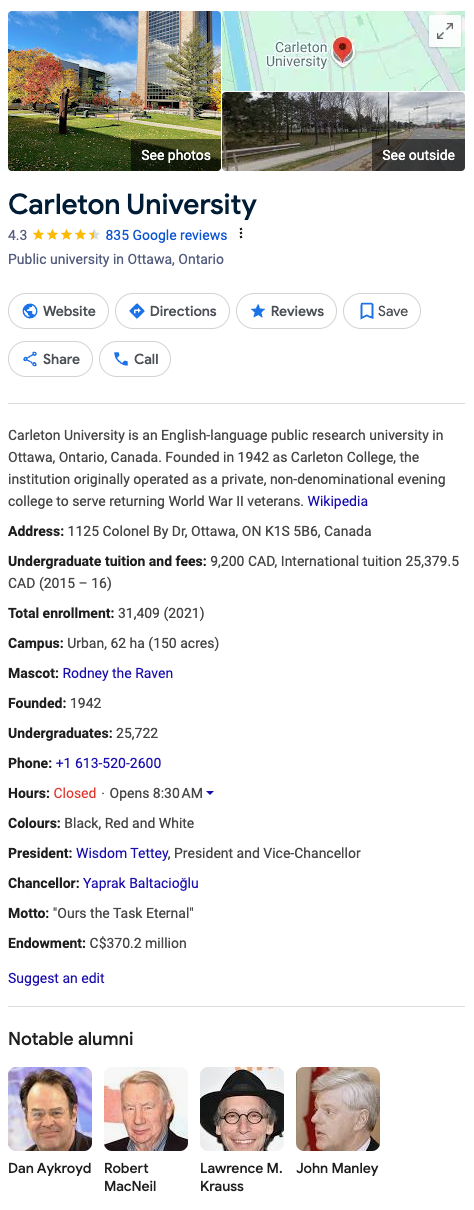
Mini Example: How Carleton University Builds Local Search Confidence
A prominent university in my hometown where my brother did his undergrad degree is a great example of leveraging local SEO.
They implement many of the tips listed above.
Profile And Location Signals
- Shows the full campus address clearly: 1125 Colonel By Drive, Ottawa, ON
- Uses campus maps and location pins to help students find buildings and facilities
- Provides practical visit information, including transit, parking, and accessibility details
Website And Content Signals
- Builds location relevance around Ottawa, Canada’s capital, and Ontario
- Uses campus and city content to help students picture daily life outside the classroom
- Connects the university’s location to nearby government, technology, internship, and career opportunities
Student Confidence Signals
- Offers a 360° campus tour so prospective students can explore the environment before visiting
- Uses seasonal campus imagery to show what the school feels like throughout the year
- Highlights local alumni, student life, neighbourhoods, and community connections
The real lesson here is that local SEO is about more than putting a city name on a page. It is about helping students and families understand the place behind the program.
And if that is not enough, prospective students can also see that Dan Aykroyd attended the school.
So as you can see local SEO is a key part of your overall higher education SEO strategy.
Your efforts optimizing your Google Business Profile and creating authentic location content lead directly to physical campus visits - which is for sure, the most powerful conversion point in the enrolment journey.
30-Day Local SEO Action Plan for Higher Education
As we've discussed, local SEO can feel messy for colleges and universities because responsibility is often split across teams.
So, best to start with the pieces that influence trust and student action first.
Week 1: Audit Your Local Search Presence
Review your main Google Business Profile first, then audit every public-facing location that needs its own profile.
Check whether each profile has the correct name, address, phone number, website link, map pin, category, photos, and review activity.
Flag any profile likely to confuse searchers.
Week 2: Fix Your Highest-Impact Campus Details
Update the profiles and pages students are most likely to use before a visit.
Prioritize the profiles and pages students use immediately before a campus visit (I.e. campus profile, admissions office, visit page, parking page, directions page, campus tour page, and high-traffic program pages).
Make sure students and families can quickly find:
- Where to go
- How to get there
- Where to park
- Who to contact
- How to book a visit
- What the campus and surrounding area look like
- What reviews and photos say about the experience
Week 3: Improve Local Content
Add local context to the pages that influence enrolment decisions.
Update program pages with local details that connect the campus to student outcomes. Improve student-life pages with local details students need to judge daily fit.
Create or refresh content around local experiences that most influence whether a student can picture enrolling.
Week 4: Build a Review and Measurement Process
Set up a simple review monitoring process across the platforms students actually use.
Look for recurring themes in positive and negative reviews. Use those themes to fix the campus content creating the same uncertainty.
Then connect local SEO reporting to meaningful actions:
- Website clicks from Google Business Profile
- Direction requests
- Calls
- Campus tour bookings
- Open house registrations
- Inquiry form submissions
- Program-page visits
- Application starts
- Application completions
The strongest local SEO strategy helps students and families move from reliable local information to a confident enrolment decision.
FAQs About Local SEO for Higher Education
What is local SEO for higher education?
Local SEO for higher education helps colleges and universities appear when location shapes which institution a searcher chooses.
It combines institution-controlled local information with third-party signals that help search engines verify relevance and trust.
Why does local SEO matter for colleges and universities?
Local SEO matters because students and families often research the place before they commit to the institution.
Before booking a tour or submitting an inquiry, students may use local search to decide whether visiting the campus feels practical.
Should every department have its own Google Business Profile?
No. A department should only have its own Google Business Profile when searchers genuinely need to find it as a separate destination.
Public-facing campus locations may qualify for separate profiles when they operate as destinations with their own visitor needs. Academic departments usually do not need profiles unless they serve visiting searchers.
What should a college or university include on a local campus page?
A strong local campus page should give prospective students everything they need to find the campus and decide whether to visit.
The page should help students and families understand the campus well enough to know their next step.
How do reviews affect local SEO for higher education?
Reviews can determine whether searchers keep considering the institution.
Students and families use reviews to spot recurring problems that official campus content may not make obvious. Colleges and universities should treat recurring review feedback as evidence for what student-facing content needs fixing.
How can universities measure local SEO success?
Universities can measure local SEO success by tracking whether local visibility leads to meaningful enrolment actions (i.e., tracking calls, campus tour bookings, open house registrations, inquiry forms, program-page visits, application starts, and application completions).
The strongest reporting connects local search visibility to real enrolment behaviour.
Need Help Improving Local SEO for Your College or University?
Local SEO can quickly become complicated when ownership is split across different parts of the institution.
We can help you turn a fragmented local search presence into a clearer path toward enrolment action.
Book a free site review and we’ll show you where your higher-ed SEO strategy has the strongest growth opportunities.

About Will James
Will is a content strategist and co-founder of 8-Bit Content. He helps businesses get more from their content and has spent more than a decade working across search, publishing, and marketing. In his free time, he’s almost certainly with family and friends, off on an adventure, learning something new, or trying to get a cat’s attention.

About Joshua James
Joshua is an education leader and co-founder of 8-Bit Content. He has spent more than 15 years helping schools grow, strengthen their digital presence, and create safer learning environments. In his free time, he’s usually with his two kids, taking on a new challenge, or pretending he has reached the end of his to-do list.



Let’s grow your online visibility together!
Get practical content tips and checklists
Contact Us
You can also find us here:
